
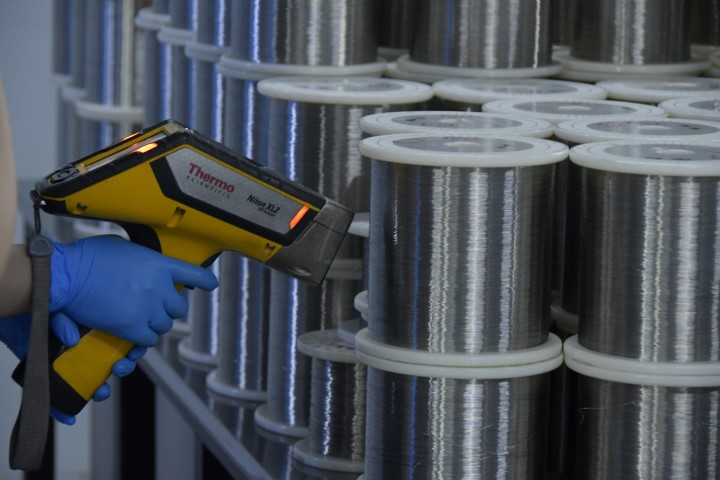
Diameter, tolerance class, traceability and packaging decide the wire you get.
Don’t Just Order “Type K Wire”
The phrase “Type K thermocouple wire” underspecifies the product by a wide margin. Without specifying diameter, tolerance class, surface finish, packaging and traceability requirements, you will receive whatever the supplier has in stock — which may or may not suit your application.
Here are seven questions to answer before placing an order.
1. Which Thermocouple Type?
This determines the alloy pair and the EMF vs. temperature curve.
| Type | Alloy Pair | Best For |
|---|---|---|
| K | Chromel / Alumel | General purpose, oxidising, <1000 °C |
| N | Nicrosil / Nisil | High-temp, vacuum, long-term stability |
| J | Iron / Constantan | Reducing atmospheres, <750 °C |
| T | Copper / Constantan | Sub-zero, cryogenic, pharma |
| E | Chromel / Constantan | Highest sensitivity, non-magnetic |
Not sure? Send us your temperature range and atmosphere — we recommend the right type.
2. What Product Form?
| Form | Best For |
|---|---|
| Bare Wire (solid) | General purpose, static installations |
| Stranded Wire | Vibration, flexing, thermal cycling |
| Alloy Ingots / Wire Rod | Upstream raw material, custom melts, private alloy formulations |
3. What Diameter?
| Application | Typical Diameter |
|---|---|
| Ultra-fast response (engine test) | φ0.025–0.1 mm |
| General laboratory | φ0.25–0.5 mm |
| Industrial furnace | φ0.5–1.0 mm |
| Heavy industrial / long life | φ1.0–3.0 mm |
Halving the diameter improves response time ~4×. Doubling it extends fatigue life ~3×.
4. What Tolerance Class?
| Standard | Best Class | Industrial Class |
|---|---|---|
| IEC 60584-1 | Class 1 (±1.5 °C or ±0.4%) | Class 2 (±2.5 °C or ±0.75%) |
| ASTM E230 | Special Limits | Standard Limits |
Class 1 / Special Limits costs 10–20% more but is mandatory for aerospace (AMS 2750) and pharmaceutical validations.
5. What Traceability Do You Need?
- Basic: Certificate of Conformance (no test data)
- Standard: MTC with chemical composition and dimensional report
- Full: MTC + EMF calibration data + furnace batch number + retrievable test archive
For aerospace, power generation and pharmaceutical applications, specify full traceability with furnace batch number.
6. What Packaging?
- DIN 125 spool (standard, 5–20 kg)
- DIN 160/250 spool (larger quantities)
- Coil (bulk, no spool)
- Custom reel (OEM private labelling available)
7. How Do You Qualify the Supplier?
Before placing a volume order, ask for:
- A sample spool (10–50 m) with full MTC
- The supplier’s ISO 9001 certificate
- A reference customer in your industry
- Confirmation that the wire is manufactured in-house (not traded)
At RAS Thermal, we manufacture every metre of thermocouple wire in our own facility — from vacuum induction melting to precision wire drawing. We provide free sample spools for qualified OEMs. Request a sample →
RFQ Checklist
Copy this into your enquiry:
Thermocouple Type: _______
Product Form: Bare Wire / Stranded / Alloy Semis
Condition: Hard / Soft / Bright finished
Diameter: φ_______ mm
Tolerance Class: IEC Class 1 / 2 or ASTM Special / Standard
Quantity: _______ kg / metres
Packaging: DIN 125 / 160 / 250 / Coil / Custom
Standard: IEC 60584-1 / ASTM E230 / Dual
Traceability: Basic / Standard / Full
Surface Finish: Bright / Oxidised / Electro-polished
Target Delivery: _______ weeks
Ready to order? Request a quote → with your specification and we reply with price and lead time within one business day.
Frequently Asked Questions
What information do I need before ordering thermocouple wire?
Seven points: thermocouple type, product form (bare, stranded or alloy semis), diameter, tolerance class, traceability level, packaging, and how you qualify the supplier. "Type K wire" on its own underspecifies the product by a wide margin.
Which tolerance class is mandatory for aerospace and pharmaceutical work?
IEC Class 1 or ASTM Special Limits. It costs 10–20% more than Class 2 / Standard Limits but is required for AMS 2750 pyrometry and pharmaceutical validation, where every sensor must be calibrated and traceable.
How do I check that a supplier actually manufactures the wire?
Ask for four things: a 10–50 m sample spool with full MTC, the ISO 9001 certificate, a reference customer in your own industry, and explicit confirmation that the wire is drawn in-house rather than traded.
What traceability level should I specify?
Basic is a Certificate of Conformance with no test data. Standard adds an MTC with chemical composition and dimensional report. Full adds EMF calibration data, the furnace batch number and a test archive retrievable by batch number.
Bottom line: Under-specified orders receive whatever the supplier happens to have in stock. Fix the seven variables — type, form, diameter, tolerance class, traceability, packaging and supplier qualification — in writing before the RFQ goes out, and the delivered wire will match what the application actually needs.